
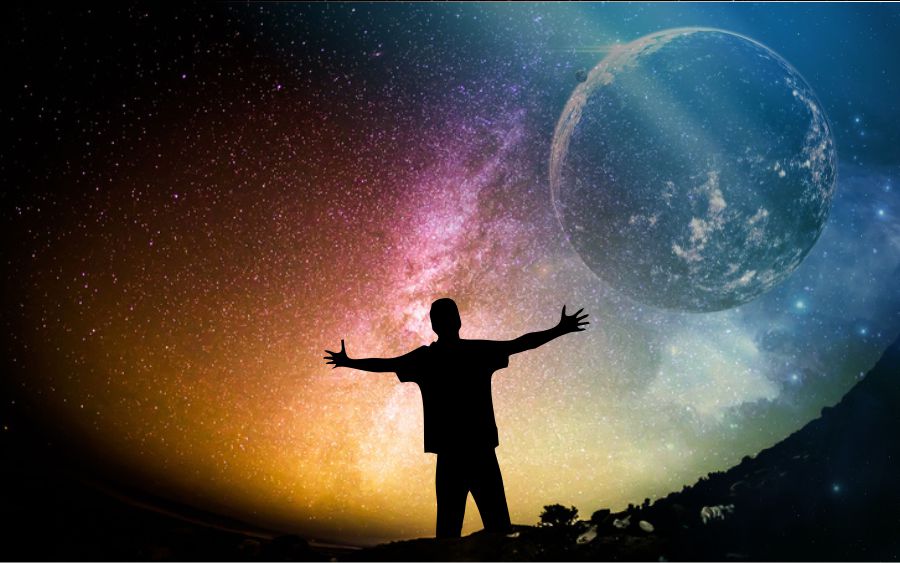
On a quiet, starry night, when all are asleep, one can hear the Universe singing. As night gently steals in and treacherous sleep casts its veil, day begins for those who listen to the Cosmic Orchestras. And they resound – filling space with themselves, like stories about the secret, which is hidden for special ears. Only in stillness can this sound be heard – a sound that, like a cosmic ship, carries the listener away into distant worlds.
The clamour of day smothers the musical expressions of space; thus, when day arrives, night descends for those rare ears that listen. Day is ever in haste, ever in motion, and to truly hear, one must learn to stop and turn the gaze inward. A gaze directed within oneself can catch and discern the subtlest manifestations of word and sound.
Word and sound have four levels of speech and essential manifestation, from the coarsest to the most subtle:
- Vaikhari – the acoustic sound and spoken word we hear and perceive with our physical senses.
- Madhyama – the inner speech, the verbal images that arise within us and stand behind the acoustic manifestation of the spoken word.
- Pashyanti – an exceptionally attentive person can experience Pashyanti in the interval between two thoughts. In that moment, one may glimpse the radiant pure Self – as consciousness, as the thread that connects one thought to the next. I am That!
- Para (Paravach) – the subtlest form of language, the highest and transcendent word and sound, consisting solely of pure awareness of the true “Self”. Para is only the “Self”.
This progression – as the word-sound manifests from its grossest form to its subtlest – can also be seen in the everyday life and creative work of an artist, composer, or performer:
- Vaikhari: At this level, interaction is possible because the creation takes tangible form – a painting, musical score, or the acoustic sound produced by a performer.
- Madhyama: Before a painting, score, or sound appears outwardly, the artist, composer, or musician forms a mental image of the creation. At this stage, the creation shines within the author as Madhyama.
- Pashyanti: Before the mental image arises, a subtle creative impulse emerges deep within – felt as a tremor, a stirring, a movement of something special. At this level, the work exists in a latent, unmanifest state – Pashyanti – within the inner world of the artist, composer, or performer.
- Para (Paravach): On the highest and most subtle level, encompassing all previous stages (Vaikhari, Madhyama, Pashyanti), the creation exists as potential creative force in the very core of the master. Here, the work manifests as pure consciousness – Para, the Highest Word.
Once I had a dream in which I played music on a guitar, and everyone could hear it – though the guitar had no strings. I explained to the listeners that the music was generated from within, and they heard what was sounding inside me.
The performing art of a singer or an instrumentalist is, above all, the art of intention. Paganini once played on a single string so masterfully that no one even noticed the absence of the others. Singing, too, is the art of intention (sankalpa). Without it, the voice distorts and becomes something other than its own true nature.
In reality, no one hears anyone else – each person hears only themselves. We live in the world, yet perceive only ourselves within it. Only what resonates with a person’s self-perception enters their field; everything else remains beyond the screen. And yet, each of us has a universal center. When what we speak arises from that center, we are heard – for then it is the Absolute speaking through us. The one whom the Absolute chooses as Its mouthpiece conveys the will of the Higher Self and finds resonance in hearts. Para, Pashyanti, Madhyama, and Vaikhari manifest from the subtlest to the physical – and this is true art and true Yoga: the union of the lower with the Higher, the limited with the Boundless, the mortal with the Immortal.